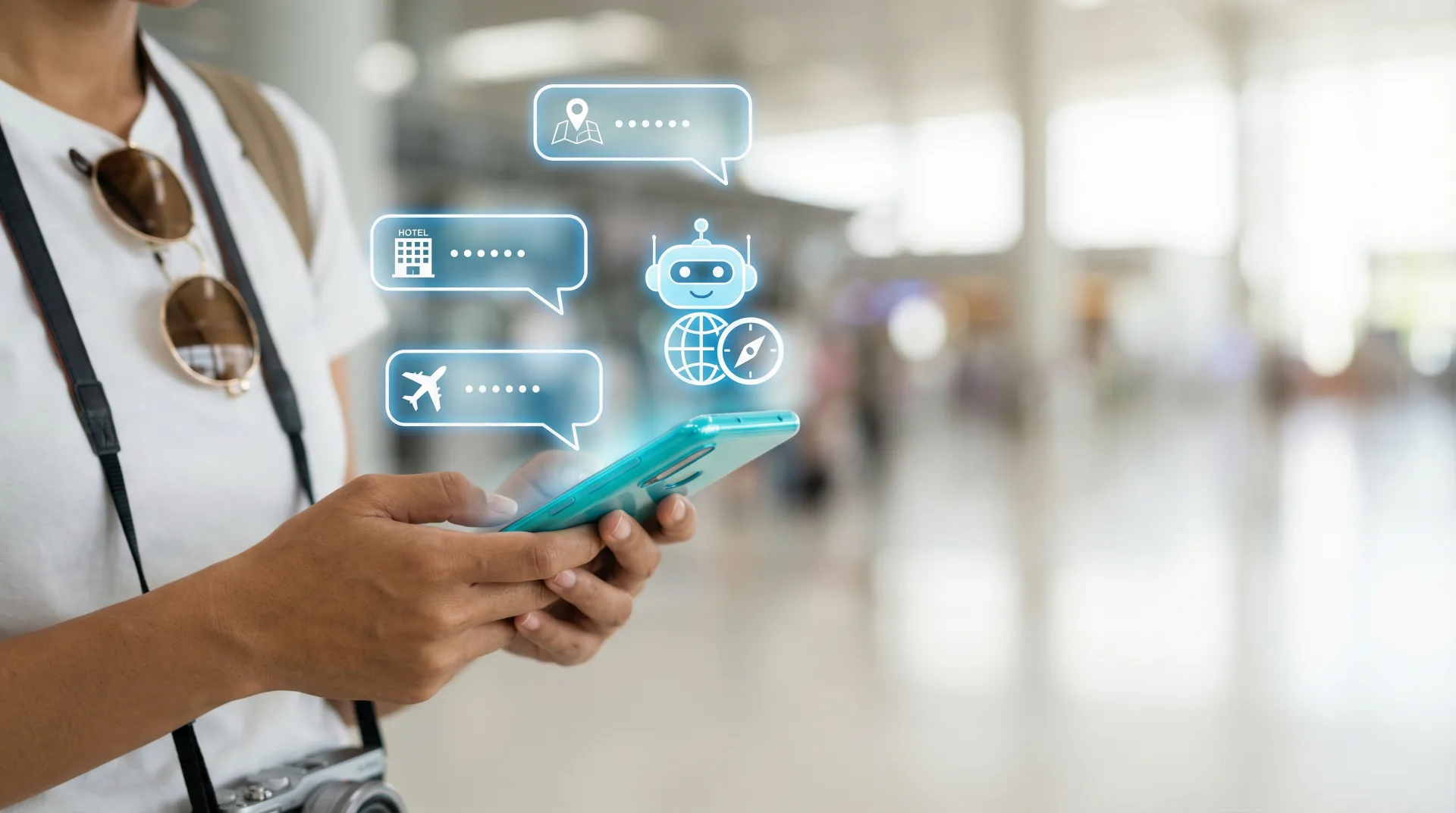
The concierge has been a cornerstone of hospitality for centuries. From the medieval "keeper of the keys" who managed access to royal residences, to the polished front desk professional who knows every restaurant in town, the role has always been about the same thing: helping guests navigate their experience with ease.
In the 2010s, the "virtual concierge" emerged as a digital extension of that role. Hotels deployed tablets, apps, and chatbots to give guests self-service access to information and basic requests. It was a step forward, but a limited one.
Now, in 2026, a new generation of AI-powered concierge platforms is rendering those early digital tools obsolete. These systems don't just display information or follow scripted decision trees. They understand natural language, take autonomous action inside hotel systems, and deliver personalized service across voice, text, and chat, all without human intervention. Platforms like withQ exemplify this new generation, combining natural-sounding voice AI with real-time operational capabilities that first-generation virtual concierges never came close to matching.
This article explains what a virtual concierge is, how the technology has evolved, and why AI is fundamentally changing what "concierge service" means in modern hospitality.
The Traditional Hotel Concierge: A Quick History
Before we talk about virtual and AI concierges, it's worth understanding what the traditional concierge role actually involves.
A hotel concierge serves as the primary link between guests and services. Their core responsibilities include booking restaurant reservations and securing hard-to-get tables, arranging transportation (airport transfers, car rentals, private drivers), providing recommendations for local attractions, events, and entertainment, handling special requests (flowers, gifts, celebration arrangements), resolving problems and coordinating with other hotel departments, and offering insider knowledge that goes beyond what a Google search can provide.
At luxury properties, the concierge is often the most experienced, best-connected member of staff. The role requires deep local knowledge, strong vendor relationships, creative problem-solving, and an almost intuitive ability to read what each guest needs.
The challenge, of course, is that this level of service doesn't scale easily. A concierge can only help one guest at a time. They work fixed shifts. They have good days and bad days. And as hotel operating models have shifted toward leaner staffing, many properties have reduced or eliminated dedicated concierge positions entirely, leaving the front desk to absorb those responsibilities alongside everything else.
What Is a Virtual Concierge?
A virtual concierge is a technology-based system that provides concierge-style services to hotel guests through digital channels rather than face-to-face interactions. Think of it as a digital version of the person behind the desk: a system guests can access to get information, make requests, and manage their stay.
Virtual concierges have taken several forms over the years.
In-room tablets were among the earliest implementations. Devices placed in guest rooms allowed visitors to browse restaurant menus, request housekeeping, check local weather, and view property information. Vendors like SuitePad and Crave popularized this format, with some properties using tablets for everything from room service orders to digital checkout.
Mobile apps expanded the concept beyond the room. Hotel-branded apps (or platform-based ones) let guests access concierge services from their phones before, during, and after their stay. Virgin Hotels' "Lucy" is a well-known example: a virtual assistant within the hotel's app that handles mobile key access, room controls, room service, and guest requests.
Chatbots brought conversational interaction to the virtual concierge. Instead of browsing menus and tapping buttons, guests could type a question or request and receive an automated response. Early chatbots were rule-based, following scripted decision trees that worked well for common questions ("What time is checkout?") but struggled with anything outside their programming.
Web-based concierge portals gave guests browser-accessible interfaces (no app download required) to access hotel information, submit requests, and explore local recommendations.
Each of these formats improved guest access to information and basic services. But they all shared the same fundamental limitation: they were reactive, rule-bound, and unable to take meaningful action inside hotel systems. A chatbot could tell you the restaurant hours, but it couldn't book you a table. A tablet could display the spa menu, but it couldn't schedule your appointment and add it to your folio.
The Limitations of First-Generation Virtual Concierges
To understand why AI is transforming the virtual concierge, it helps to be specific about where the earlier generation falls short.
Scripted, not intelligent. Rule-based chatbots follow decision trees. If a guest phrases a question in an unexpected way, the bot either misunderstands or defaults to "I'm sorry, I can't help with that. Please contact the front desk." This creates friction rather than resolving it.
Information-only, not action-oriented. Most first-generation virtual concierges are essentially digital brochures. They display information (menus, hours, maps, FAQs) but can't execute tasks. They can't check live room availability, modify a reservation, place a dining order, or schedule housekeeping. Every action still requires a human in the loop.
Channel-limited. Tablets only work in the room. Apps require a download (and most guests won't bother). Web portals require a browser session. None of these channels address what is still the most common guest communication method: the phone call.
No personalization. First-generation systems treat every guest the same. They don't know if you're a first-time visitor or a loyal regular, whether you're traveling for business or leisure, or what you ordered on your last stay. Without guest context, they can't anticipate needs or tailor responses.
No learning or improvement. Rule-based systems don't get smarter over time. They answer the same questions the same way, regardless of how guests interact with them. If a common question isn't in the decision tree, it stays unanswered until someone manually adds it.
How AI Is Replacing the Virtual Concierge
The new generation of AI concierge platforms addresses every limitation listed above. The shift isn't incremental; it's architectural. These platforms are built on fundamentally different technology (large language models, real-time system integrations, voice AI) that enables a different kind of guest service entirely.
Here's what separates AI concierges from their predecessors:
Natural Language Understanding
AI concierges use large language models to understand guest requests in natural, conversational language. A guest can say "I need a quiet table for two tonight, somewhere with good pasta" and the AI understands the intent, identifies relevant dining options, and takes action. There's no decision tree, no keyword matching, no "I didn't understand that" dead ends.
This applies equally to voice and text. Whether a guest calls the front desk, sends a WhatsApp message, or types into a web chat, the AI processes the request with the same level of comprehension.
Autonomous Task Execution
This is the most significant leap forward. AI concierge platforms with deep PMS and operational system integrations don't just understand requests; they complete them.
A platform like withQ connects natively to Oracle Opera, Cloudbeds, Mews, and WebRezPro (among others), along with spa management systems (SpaSoft, Book4Time), dining platforms (OpenTable, SevenRooms, TABLZ), and channel managers (SiteMinder, Sabre SynXis). This means the AI can book a room, modify a reservation, place a room service order, schedule a spa appointment, arrange a restaurant table, and process a late checkout, all within a single conversation, without ever involving a human staff member.
The industry term for this capability is "agentic AI": AI that autonomously manages multi-step tasks rather than simply providing information. It represents a fundamental shift from "here's the answer to your question" to "I've taken care of that for you."
Voice-First Interaction
Most guests still pick up the phone when they need something. First-generation virtual concierges largely ignored this channel. AI concierge platforms put voice at the center.
withQ answers 100% of inbound calls with natural-sounding voice AI that supports 30+ languages, responds in under one second, and operates 24/7. The voice experience is professional enough that most callers can't distinguish it from a human concierge, thanks to brand-matched voice cloning technology.
This is critical because it means the AI concierge is accessible through the most universal, friction-free channel available: the phone. No app download, no tablet navigation, no typing. Just pick up the phone and talk.
Deep Personalization
AI concierge platforms build and maintain rich guest profiles that grow with every interaction. A returning guest is recognized automatically, and the AI tailors its responses based on their history: previous room preferences, dining habits, service requests, loyalty status, and communication style.
This transforms the concierge experience from generic to genuinely personal. When the AI remembers that you prefer a high floor, always order a cortado in the morning, and asked about yoga classes on your last visit, every interaction feels like talking to someone who actually knows you.
Continuous Learning
Unlike rule-based systems, AI concierges improve over time. They learn from every interaction, refining their understanding of common requests, identifying gaps in their knowledge base, and adapting to the specific patterns of each property. A 35-property hotel management company using voice AI improved its automation rate from 80% at launch to 96% through this kind of continuous optimization.
What This Means for Hotels
The shift from virtual concierge to AI concierge isn't just a technology upgrade. It changes the operational model for guest service.
For guests, it means instant, 24/7 access to a concierge that can actually do things (not just talk about them), in their language, on their preferred channel, with full awareness of their preferences and history.
For hotel staff, it means relief from the highest-volume, most repetitive interactions. When 80% of routine inquiries are handled autonomously, your team is freed to focus on the complex, creative, high-touch moments where human judgment and warmth truly matter. The AI doesn't replace the concierge; it handles the work that was pulling the concierge away from their most impactful contributions.
For hotel owners and operators, it means measurable financial impact. Hotels using AI concierge platforms like withQ report 3x revenue growth per call (through intelligent upselling), $50,000+ in annual labor savings, 25%+ guest satisfaction improvements, and full ROI within 60 days.
For PE firms and hospitality investors, it means properties with AI concierge infrastructure are operationally leaner, more scalable, and better positioned for consistent performance across economic cycles.
The Hybrid Model: AI + Human Concierge
It's worth being explicit: AI concierges are not eliminating the human elements that make hospitality special.
The best implementation model in 2026 is hybrid. AI handles volume, consistency, and speed. Human staff handle empathy, creativity, and the moments that require genuine human connection: consoling a guest who received bad news, orchestrating a surprise proposal, navigating a complex complaint that requires judgment and discretion.
The winning formula isn't AI or human. It's AI for the 80% of interactions that follow predictable patterns, freeing humans to be exceptional at the 20% that don't.
The Bottom Line
The virtual concierge was a good idea with limited execution. It gave guests digital access to information but couldn't take meaningful action, personalize experiences, or operate across the channels guests actually use.
AI has changed the equation entirely. Today's AI concierge platforms understand natural language, execute multi-step tasks autonomously, operate across voice, text, and chat, personalize every interaction, and improve continuously over time. They don't just inform; they operate.
For hotels still relying on first-generation virtual concierge tools (or no digital concierge at all), the gap between their guest experience and what AI-equipped competitors are delivering is widening every quarter. Platforms like withQ are setting the new standard, combining natural-sounding voice AI with real-time PMS integrations that turn every guest interaction into a seamless, autonomous experience.
Ready to see what an AI-powered concierge can do for your property? Book a demo with withQ and experience the next generation of hotel concierge technology firsthand.